
Up to 12 Targets per Fluorescence Channel. Up to 72 Targets in a Single Tube.
MeltArray is a highly multiplex PCR technology that pushes standard real-time PCR far beyond the traditional multiplex ceiling. By combining fluorescence color with melting temperature (Tm) as a two-dimensional coding system, MeltArray enables the detection of up to 12 targets within a single fluorescence channel. On a 6-color real-time PCR instrument, this enables single-tube detection of up to 72 targets.
This is a major step forward for molecular diagnostics. Instead of being limited by the small number of optical channels in conventional qPCR, MeltArray expands target capacity through a scalable signal architecture that remains compatible with standard real-time PCR workflows.
What Makes MeltArray Different
Traditional real-time PCR is widely used in clinical laboratories because it is fast, accessible, and easy to implement. But its multiplexing capacity is inherently constrained: most systems can only distinguish a limited number of fluorescent colors, thereby limiting the number of targets detectable in a single reaction. MeltArray overcomes that limitation by assigning each target a unique fluorophore–Tm signature rather than relying on fluorescence color alone.
In the published PNAS study, the technology demonstrated that one optical channel can resolve 12 distinct Tm-coded targets, and the paper explicitly notes that a six-color instrument could therefore support up to 72 target sequences in a single closed-tube PCR assay.
Huang Q, Chen D, Du C, et al. Highly multiplex PCR assays by coupling the 5′-flap endonuclease activity of Taq DNA polymerase and molecular beacon reporters. Proc Natl Acad Sci U S A. 2022;119(10):
How MeltArray Works
MeltArray is built on a novel coupling of three mechanisms:
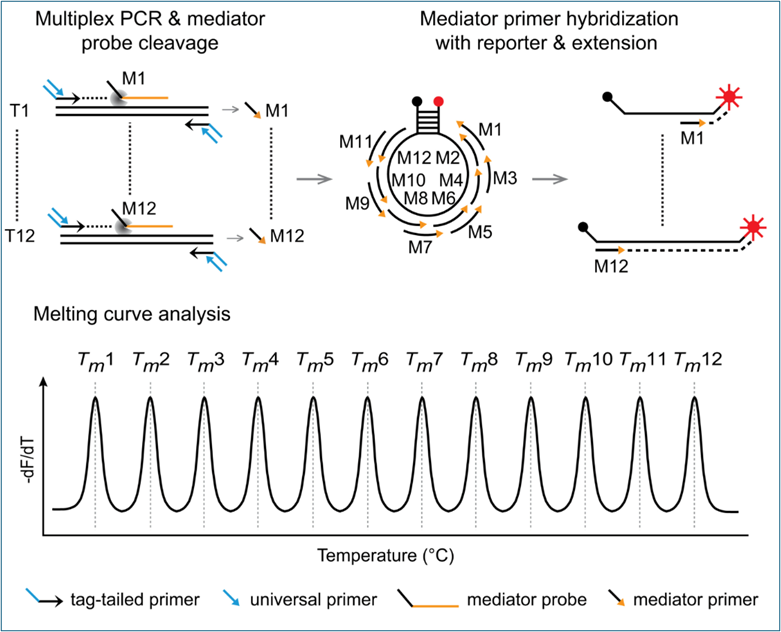
1. Target-specific mediator probe cleavage
During amplification, the 5′-flap endonuclease activity of Taq DNA polymerase cleaves target-bound mediator probes into mediator primers. These mediator primers function as endogenous target-specific barcodes.
2. Molecular beacon–based signal generation
Each mediator primer binds to a predefined site on a molecular beacon reporter. Different mediator primers bind at different positions, creating fluorescent hybrids with distinct melting temperatures.
3. Two-dimensional target identification
Each target is identified by the combination of:
fluorescence channel
melting temperature (Tm)
Core Advantage: 12 Targets per Channel
A defining strength of MeltArray is that each fluorescence channel can resolve up to 12 different targets. This is achieved by designing mediator primers that generate 12 differentiable melting peaks within a single channel. The published study reports a Tm range broad enough to support this design with high reproducibility, and repeated measurements showed tight Tm consistency suitable for robust discrimination.
That means:
1 channel = up to 12 targets
6 channels = up to 72 targets
1 reaction tube = up to 72 targets on a 6-color system
For the website, this is the simplest and strongest way to state the value proposition: MeltArray transforms standard multi-color qPCR into a true high-multiplex platform.
Key Technical Advantages
1. 72-plex potential in a single closed tube
MeltArray is designed for high-density multiplexing without opening the tube after amplification. The published platform architecture supports up to 72 targets in one tube when deployed on a six-color real-time PCR instrument.
2. High multiplexing without complex instrumentation
Unlike sequencing-based workflows, MeltArray operates on a real-time PCR thermal cycler, making it much more accessible for routine molecular laboratories.
3. Lower probe burden and lower fluorescence background
Because multiple targets can share one molecular beacon reporter, MeltArray reduces the number of fluorogenic reporters required compared with many conventional multiplex probe systems. This lowers assay complexity, reduces fluorescence background, and improves scalability.
4. Strong specificity from molecular beacons
The PNAS study showed that molecular beacons outperform corresponding linear probes in this format by producing lower background and cleaner melting behavior, which are especially important in high-multiplex assays.
5. Built-in suppression of primer-dimers
MeltArray incorporates HANDS (Hom-Tag Assisted Non-Dimer System) to suppress primer-dimer amplification, helping preserve analytical sensitivity in highly multiplex reactions.
6. Real-time and end-point detection in one platform
MeltArray can also be combined with real-time PCR quantification, allowing both qualitative multiplex identification and quantitative detection in the same overall system, depending on assay design.
Published Applications
The original PNAS paper demonstrated MeltArray across several high-value use cases:
20-plex assay for Y chromosome microdeletions
A 20-target assay successfully detected all target regions in healthy male samples and identified microdeletions in clinical testing. The assay remained reproducible across a wide input range, from 100 ng down to 100 pg of genomic DNA per reaction.
62-plex assay for E. coli serovar identification
Using a six-color thermal cycler, MeltArray generated 62 distinct fluorophore–Tm combinations to identify 61 O genotypes plus one E. coli-specific gene. The figure on page 6 shows how different targets are distributed across multiple optical channels and Tm windows.
24-plex respiratory pathogen assay
MeltArray was coupled with real-time PCR to identify 20 targets qualitatively while quantifying four bacterial pathogens in the same reaction. The reported limit of detection was approximately 10 copies/μL per pathogen, and results showed 100% concordance with singleplex real-time PCR assays in tested clinical samples.
KRAS mutation minisequencing
MeltArray also demonstrated single-nucleotide discrimination in KRAS mutation testing. In the published study, the assay detected mutant allele fractions of 5–10%, outperforming conventional Sanger sequencing for low-frequency mutation detection.
Extended into FFPE Oncology Testing
A later Laboratory Investigation study extended MeltArray into a more advanced oncology workflow for mutation analysis of FFPE tissue. By coupling MeltArray with sequence artifact elimination and mutation enrichment, the platform identified 13 PIK3CA hotspot mutations in FFPE tissues, with a reported detection range of 0.05% to 0.5% mutant allele fraction, all within under 5 hours.
The study also reported:
23.5- to 59.4-fold mutation enrichment
elimination of FFPE-related sequence artifacts to undetectable levels in tested normal samples
full concordance with ddPCR in the evaluated clinical cohort
detection of additional low-MAF mutations missed by NGS in the comparison subset
This demonstrates that MeltArray is not only a multiplexing concept, but a platform with clear translational potential in molecular pathology and companion diagnostics.
Why MeltArray Matters for the Future of PCR
MeltArray changes the economics and capability of PCR-based testing. It brings together:
the accessibility of qPCR
the scalability of two-dimensional coding
the specificity of molecular beacons
the practical need for high target density in one reaction
Most importantly, it does so while preserving a closed-tube format and using instrumentation already familiar to clinical laboratories.
(Courtesy to Zeesan Technology)